Customer Feedback
|
Feedback |
Date / Time |
|
|
Greatest eBayer!!! Wonderful item! Extremelly fast shipping! More thanks!!! |
Jan-05-10 |
|
|
Dual HSTL SSTL LVPECL LVDS to LVTTL Translator IC QTY10
(#330378567365) |
|
|
|
Greatest eBayer!!! Wonderful item! Extremelly fast shipping! More thanks!!! |
Jan-05-10 |
|
|
7474 G Series GHz TTL CMOS logic IC 14pin SOIC QTY-10
(#330223377254) |
|
|
|
The 74G series are really cool, tested with 533Mhz with no
issues. Thx ! |
Jan-05-10 |
|
|
7474 G Series GHz TTL CMOS logic IC 14pin SOIC QTY-10
(#330223377254) |
|
|
|
PERFECT SERVICE, THANK YOU!! Best seller, thanks |
Dec-19-09 |
|
|
High Bandwidth 4:1 Mux DeMu IC 3253 16pin TSSOP QTY10 (#330344847853) |
|
|
|
Perfect vendor. Todo perfecto.
Gracias |
Nov-11-09 |
|
|
7474 G Series GHz TTL CMOS logic IC 14pin SOIC QTY-10
(#330223377254) |
|
|
|
Perfect vendor. Todo perfecto.
Gracias |
Nov-11-09 |
|
|
7404 G Series GHz TTL CMOS logic IC 14pin SOIC QTY-10
(#330223128357) |
|
|
|
Perfect vendor. Todo perfecto.
Gracias |
Nov-11-09 |
|
|
High Bandwidth 4:1 Mux DeMu IC 3253 16pin TSSOP QTY10 (#330344847853) |
|
|
|
Perfect vendor. Todo perfecto.
Gracias |
Nov-11-09 |
|
|
GHz High Bandwidth 4:1 Mux DeMu IC 14 16pin TSSOP QTY10 (#330284537127) |
|
|
|
Great product, Very cheap. Well packed. Recommended. |
Sep-30-09 |
|
|
-- (#330223172709) |
|
|
|
Great product, Very cheap. Well packed. Recommended. |
Sep-30-09 |
|
|
-- (#330223130932) |
|
|
|
Received item quickly in excellent working condition. |
Sep-16-09 |
|
|
-- (#330282652273) |
|
|
|
Received item quickly in excellent working condition. |
Sep-16-09 |
|
|
-- (#330229719196) |
|
|
|
Good Seller, quick dispatch, highly recommended |
Aug-17-09 |
|
|
-- (#330344849361) |
|
|
|
Everything OK |
Jul-27-09 |
|
|
-- (#330223418637) |
|
|
|
Everything OK |
Jul-27-09 |
|
|
-- (#330251819921) |
|
|
|
Excellent seller! Instant shipping. High quality item. Thanks! |
Jul-11-09 |
|
|
-- (#330223129649) |
|
|
|
Excellent transaction with quick delivery |
Jun-11-09 |
|
|
-- (#330223114487) |
|
|
|
excellent in every way, thank |
Jun-09-09 |
|
|
-- (#330223377702) |
|
|
|
Perfect vendor.++++++ |
May-12-09 |
|
|
-- (#330284518830) |
|
|
|
Good, clean transaction |
Feb-12-09 |
|
|
-- (#330223378332) |
|
|
|
Good, clean transaction. |
Feb-12-09 |
|
|
-- (#330223378332) |
|
|
|
Sorry to hear about the story of Hyung
Seok Kim. I highly recommend potatosemi! |
Dec-24-08 |
|
|
-- (#330223914842) |
|
|
|
Quick Postage, everytime again |
Oct-31-08 |
|
|
-- (#330223377254) |
|
|
|
Quick Postage, everytime again |
Oct-31-08 |
|
|
-- (#330223114487) |
|
|
|
all ok, good and quick service |
Oct-30-08 |
|
|
-- (#330229721145) |
|
|
April 17, 2008
74G
clock buffer
|
Feedback from PotatoSemi: |
|
I
will like to share & discuss some technical information with you. When you
use our clock buffer, we prefer that you can connect the entire clock buffer
outputs without any open circuit. For example, when you use 3807 1 to 10
clock buffer, the best case will be 10 outputs connect to 10 similar loads.
If in case that you only use 9 outputs, please add a dummy loading capacitor
to the 1 left open output to make the termination. So the 10 output signals
will switch about the same time. Any output signal without loading will
switch much faster then the other output signal with loading. Much faster
switching & delay time from open output signal will increase noise &
jitter. The equal loading & same output trace length are important when
you use clock buffers. Please let me know if you have any question or
comment. |
|
Comments: |
|
I understand
your comment and usually terminate unused outputs. However, I have wondered
what the tradeoff is between equalizing loading and delta I noise. If you leave the unused outputs
open circuited, you will get a noise spike that is not coincident with the
other channels. However, the current spike is mostly due to the overlap of
PMOS/NMOS switching. If you add a load capacitance, you then add the current
spikes from charge/discharging the load capacitance to the current spikes.
How large are the two components? |
|
Feedback from PotatoSemi: |
|
CMOS circuits have been used for over 50 years.
All the CMOS circuit ICs have spike except potato chips. We have the technology
to kill the spike so our products can run much higher frequency. You can see
the comparison from the attached file. The left side is our 3807 with noise
kill circuit. The right hand side is the normal 3807. All of them are running
in same condition with 10 outputs switching at the same time. The output is
driving 15pf loading. Now, you can see why the 3807 from other semiconductor
companies can not run beyond 200MHz. Spike is the only reason. People also
call them ground bounce or noise. Jitter is also related to the noise. They
are all the same thing. We make our noise kill circuit perfect matching 8pf
loading. If your loading is more far away, the chip ground noise will
slightly higher. You can see the attached file for example. That output is driving
15pf loading. This is the reason we recommend our customers to add 8pf
termination capacitor to the open output. This termination capacitor is only
good for our GHz CMOS output circuit. Termination capacitor is no use to the
regular CMOS outputs. This is just like what you said. They are going to be
noisy anyway which does not matter you add the capacitor or not. |
|
Comments: |
|
Thanks for the information. In my
specific application, I am driving a 50 ohm transmission line with an AC coupled
50 ohm termination. Do you still recommend using the same load as a dummy
termination for unused outputs? |
|
Feedback from PotatoSemi: |
|
Yes.
I still recommend adding 8pf dummy termination for unused outputs. Our noise kill
circuit will work anyway which does not matter the loading is 0pf or 15pf.
The 8pf dummy is only for the fine tune. Of cause, the best scenario is no
dummy output. All the dummy outputs will waste power.. |
March 01, 2008
74G
clock buffer
I measured
the 1:4 and
edge speeds. The 1:4 measured at 256psec and 272psec rise/fall.
(This compares with 204psec rise and 284ps fall for the 1:2 buffer).
The average is slightly slower, but the edges are more symmetrical.
I expected
the 1:4 might be slightly slower due to the larger fan
out internal to the buffer than for the 1:2. However, I expected
that since the
1:2 package heavily favors the GND return path, that
the fall time
would be much faster than the rise time, contrary to the
measurements.
The
still, but very symmetrical edges.
Thank you,
------/ --/ -----/ -----/IBM@IBMUS
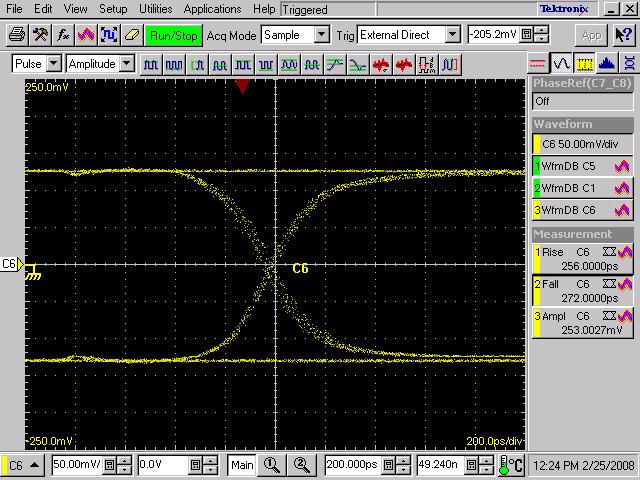
Drive 50 Ohm load
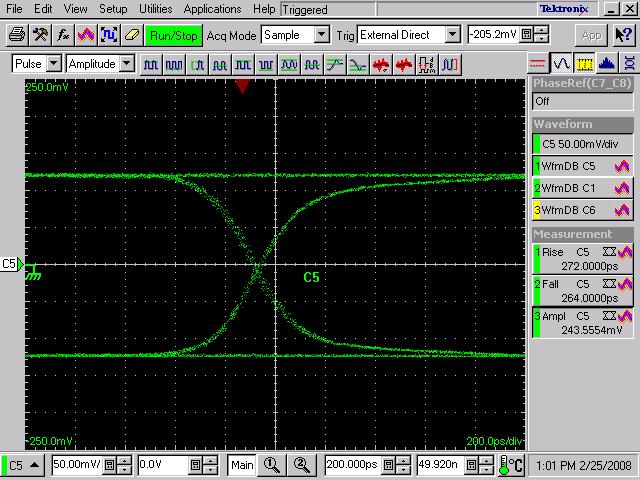
Drive 50 Ohm load
February 06, 2008
PO100HSTL23A
We just
finished testing this device (PO100HSTL23A) in several circuits
on a new product and found its performance to be OUTSTANDING. We are
definitely going to look at using it in our other products to improve
yield and jitter performance. The ability to drive different impedance
loads with well behaved "fast" edges (on-board as well as coax cables)
with very little power supply noise is amazing.
I just want
to thank your company for making this product. We will
seriously be looking at your other products to see how we can use them
in existing and future products.
Lastly, if
you want to send us some literature on how you pulled this
off I would be very interested. I would also appreciate any Spice
models if you have any available. They can be pseudo models as long as
their transmission line properties are retained.
Thanks,
--
Chase Scientific Company